
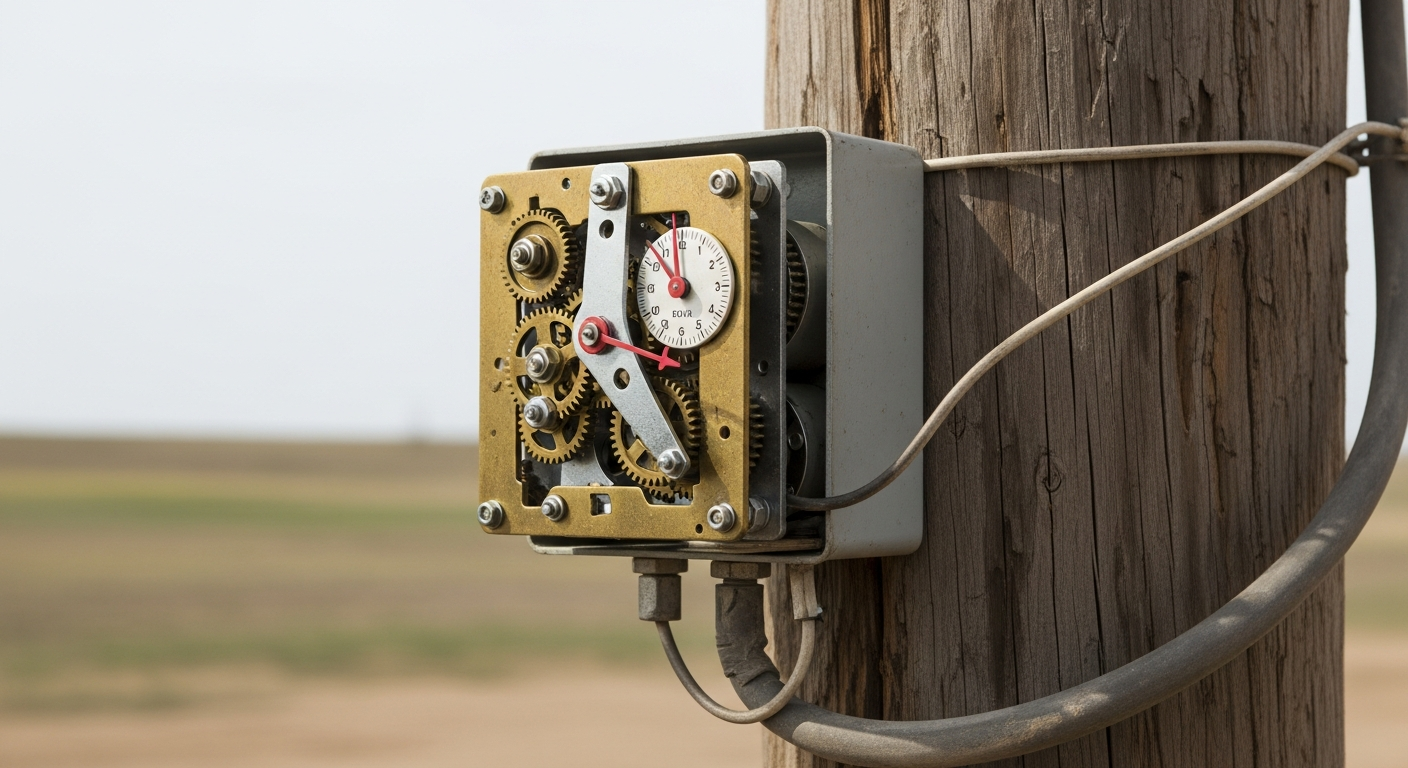
Most rod-pumped wells cannot produce 24 hours a day. The reservoir cannot supply enough fluid to match the pump's displacement. Running the unit continuously against an inadequate inflow is the single most common cause of rod failures, pump damage, and inflated energy bills on mature wells. A percentage timer is the simplest possible fix and it works on most marginal producers.
What Continuous Pumping Actually Does to a Pumped-Off Well
Fluid pound. Every downstroke, the plunger slams into a partially empty barrel. Shock loads travel through the rod string, accelerating rod failures, pump damage, tubing wear, and gearbox stress. The energy cost of running a unit that is not lifting fluid is pure waste. You pay for the kilowatts to move the rod string up and down with no production in return. Run life on every component drops.
What a Timer Does About It
The timer shuts the unit off for a preset interval. During the off interval, fluid builds up in the annulus above the pump. When the unit restarts, the pump encounters a full barrel and produces at design fillage until the well pumps off again. Then the cycle repeats. Running 4 hours on, 20 off - or 30 percent of each 30-minute cycle - matches pump runtime to actual inflow on most low-rate wells.
How to Set the Schedule
Measure the well's inflow. Fluid level shots before and after a run cycle tell you how fast the annulus fills and how long the pump takes to pump it down. Set the timer so the pump runs the available fluid down to healthy submergence, then shuts off for long enough to recover.
A well that produces 80 barrels a day from a pump rated for 400 needs to run roughly 20 percent of the time. A timer set to 4 hours on, 16 off is close. Fine-tune based on fluid level shots and dynamometer readings over the first few weeks.
When a Timer Is Not Enough
Wells with inflow that varies day to day or week to week need pump-off control rather than a fixed timer. Wells with significant free gas need gas separation first and timing second - a timer does not solve gas lock. High-rate wells that genuinely fill the pump most of the day do not need intermittent operation and sometimes lose production if you impose it unnecessarily.
Bottom Line
A timer on a low-inflow well pays for itself in rod life alone. Add energy savings and avoided workovers and the payback is often measured in weeks. Every continuously-running rod pump on a declining well is a candidate for a timer, and the inexpensive fix usually beats the expensive diagnostic.