
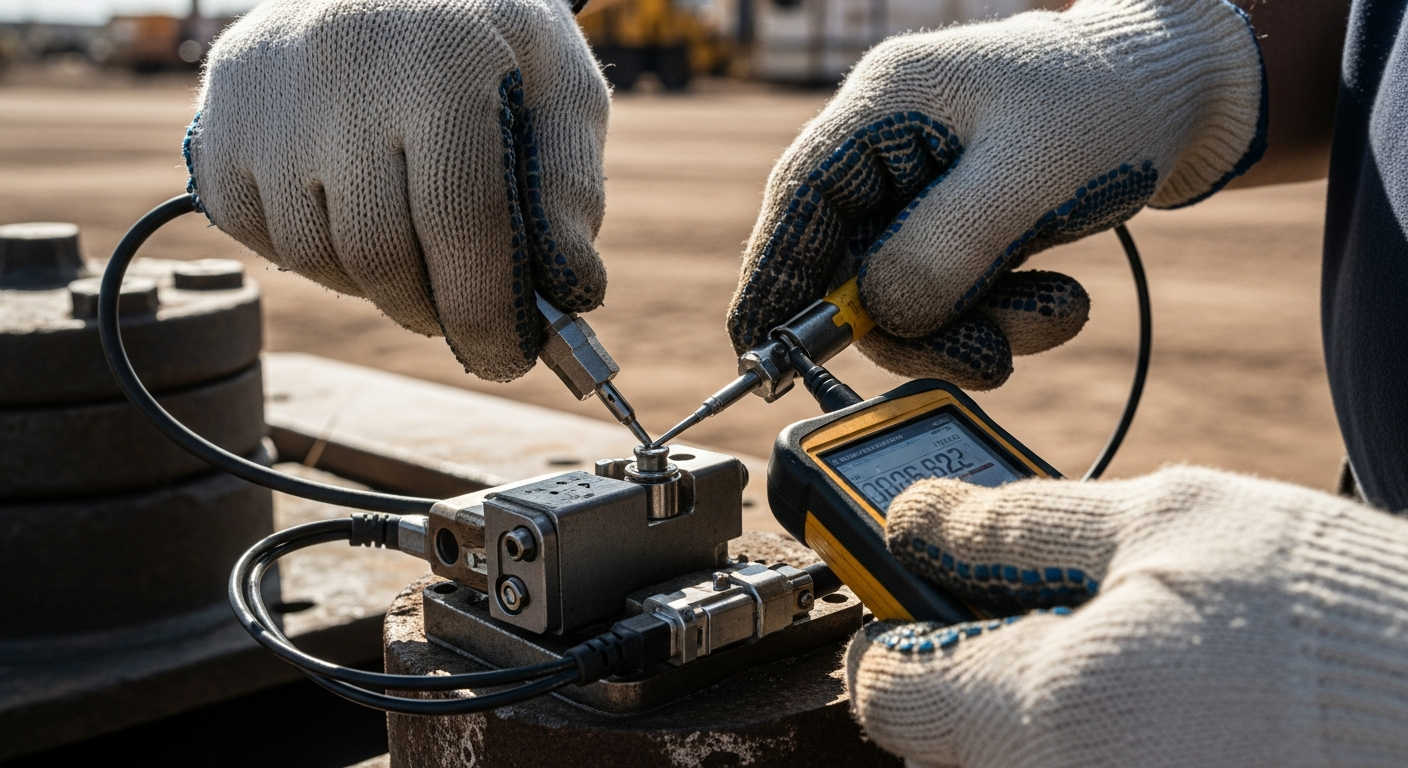
A miscalibrated load cell is worse than no load cell. It gives confident readings that lead to wrong conclusions. Card shapes, counterbalance calculations, peak load diagnostics - all of them are derived from the load cell signal. If the signal is off by 10 percent, every downstream analysis is off by 10 percent in ways that are hard to detect. Calibration takes about 20 minutes and most operations never do it.
What a Load Cell Does
The load cell measures tension on the polished rod. Typically a strain gauge in a donut clamped around the polished rod, or an inline pin sensor. The signal goes to the dynamometer system and becomes the Y-axis of every surface card.
Zero drift, gain drift, temperature sensitivity, and aging all affect load cells. A cell that was calibrated two years ago may read accurately or may be 15 percent off. Without calibration, there is no way to know.
When to Calibrate
At installation. After any major service (replacing cable, electronics, or mounting hardware). Annually on a wellness check schedule. Before any important measurement (counterbalance adjustment, capacity test, peak load investigation).
The Procedure
Isolate the load cell from service loads. Remove the rods or use a calibration frame that applies known loads independent of the well.
Apply known loads in increments. A calibration weight set or a hydraulic cylinder with a reference load cell. Record the output reading at each applied load.
Compare measured vs applied across the range. Plot the residuals. The response should be linear. Non-linearity indicates a problem with the cell itself.
Adjust zero and gain in the dynamometer system to match the calibration. Most dynamometer software allows this directly. Document the calibration - date, technician, reference loads used, before and after readings.
Common Mistakes
Calibrating with the rods installed and the pumping unit still in operation. Any well load contaminates the measurement. Isolate first.
Using a single-point calibration instead of multi-point. A cell can be accurate at zero and at 20,000 lbs and still be nonlinear in between. Multi-point reveals this.
Not documenting. Without a record you do not know whether the cell has drifted since last calibration.
Bottom Line
Load cell calibration is the unsexy maintenance task that quietly determines whether your diagnostic program is working. 20 minutes once a year. Skipping it means every card, every counterbalance check, every torque calculation carries uncorrected error. Do it on schedule and the rest of the diagnostic toolkit becomes trustworthy.