
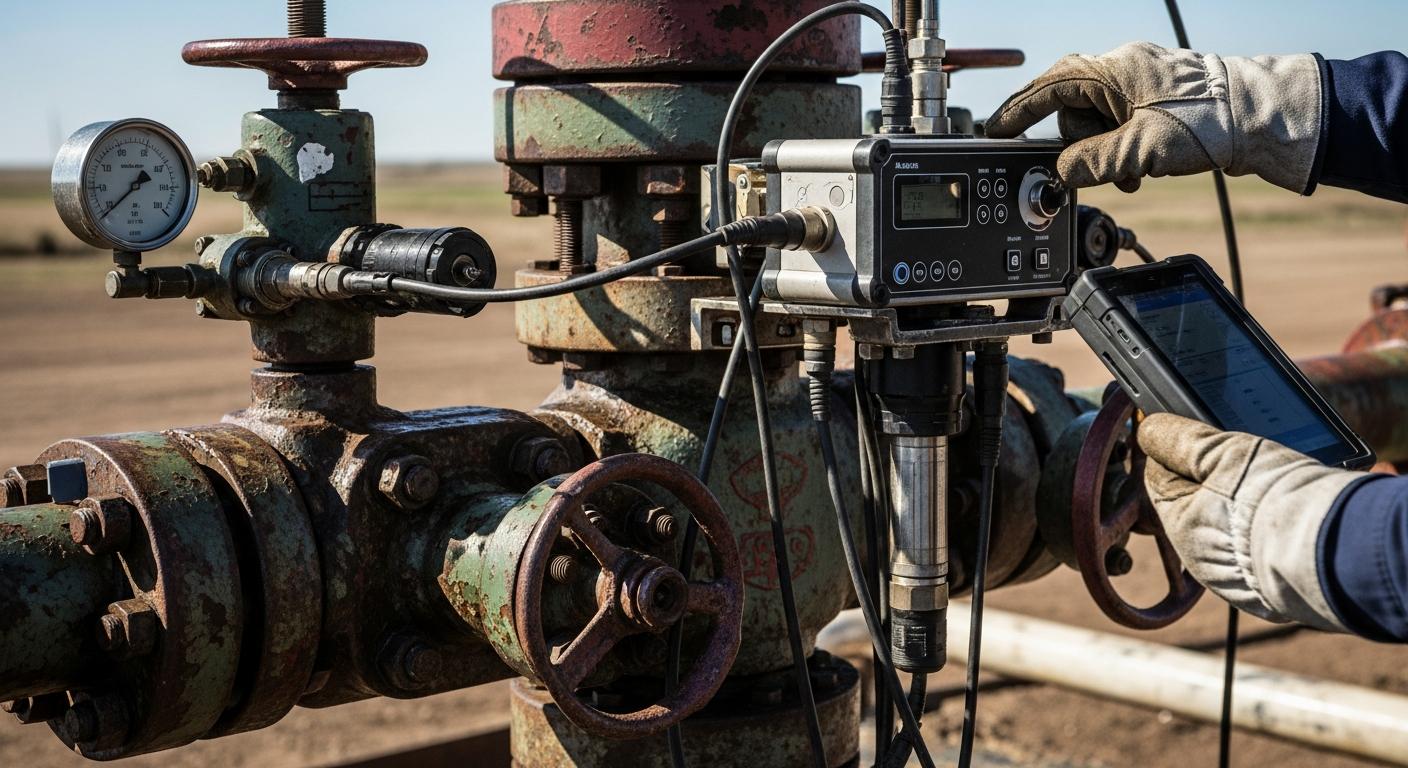
An acoustic fluid level shot takes 10 minutes, costs nothing to run once you own the gun, and tells you more about rod pump operation than almost any other single test. Combined with a dynamometer card, it is the standard diagnostic starting point. Here is what it measures, how to read it, and what it is actually telling you about the well.
How the Measurement Works
A gas gun (nitrogen or CO2) attached to the casing wing valve releases a pressure pulse. The acoustic wave travels down the annulus, reflects off tubing collars at known depth, and reflects strongly off the gas-liquid interface. The time-of-flight to each reflection gives depth. Modern tools like Echometer's Well Analyzer record the echoes and calculate depths automatically.
What You Get Out of It
Depth to liquid level in the annulus. This alone tells you pump submergence - how much liquid the pump is drawing from. Pump intake pressure (PIP) calculated from fluid column height, gas column pressure, and fluid density. Bottomhole pressure approximation using the PIP and pump depth. Fillage estimate from the pressure buildup curve after shutdown (if you run a pressure transient as part of the test).
Reading Pump Submergence
Low submergence (liquid level at or near the pump intake): the well is pumped off or nearly so. Fluid pound is happening or imminent. Timer or POC needed, SPM should drop, or the reservoir is not supplying what the pump is trying to move.
High submergence with poor production: the pump is not filling despite having liquid available. Gas interference is the most common cause. Mechanical issues like standing valve leakage also produce this pattern. Dynamometer card distinguishes between the two.
Balanced submergence with design production: pump and inflow match. Look for reasons to optimize (energy, run life) rather than to fix.
Pump Intake Pressure
PIP drives productivity index calculations. Comparing PIP to static reservoir pressure tells you the drawdown the well is operating under. Low drawdown at full pump runtime suggests the pump is holding the reservoir to its deliverability. High drawdown with poor production suggests skin damage, depleted reservoir, or inadequate pump capacity.
Common Mistakes
Running the shot while the unit is operating introduces noise that obscures reflections. Stop the unit, wait for the annulus to stabilize, then shoot. Not accounting for gas column pressure distorts the PIP calculation. Use the measured surface gas pressure and the known gas gravity, not assumptions. Mistaking a false reflection (tubing leak, pump intake) for the liquid level sends you to the wrong diagnosis. Compare against historical shots and check that depth makes sense.
When to Run Them
Routine: monthly or quarterly on every rod-pumped well. Catches drift in fluid level before it causes damage. Investigative: whenever production, dynamometer card, or motor current shifts noticeably. The shot confirms or rules out fluid level as the cause. Before and after: bookend any operational change (timer schedule change, SPM change, stroke length) with fluid level shots to measure the effect.
Bottom Line
Acoustic fluid level shots are cheap, fast, and diagnostically dense. Combined with dynamometer cards they cover most of the diagnostic ground on a rod-pumped well. Teams that run them routinely catch problems weeks before production drops, which is where the economics are.